

Commercial solar for Phuket businesses
Electricity is one of the largest controllable costs in a hotel, restaurant or production facility. A properly designed rooftop system turns that variable cost into a fixed, falling one.
Businesses get the best returns from solar
Solar pays back fastest when you consume what you generate. Most businesses run their heaviest loads — air conditioning, refrigeration, pumps, machinery, lighting — during exactly the hours the sun is strongest.
That means little or no wasted export, and payback periods that are typically shorter than residential. Commercial systems also cost less per kilowatt as they scale.
We start with your load profile, not your roof. Before designing anything we look at how and when you actually consume power. Sizing to the roof rather than the load is the most expensive mistake in commercial solar.
Indicative commercial system
For a business with an average monthly electricity bill of around ฿40,000.
Guidelines only — real figures follow a load study and site survey.
Built for how Phuket businesses actually operate
Different sectors have very different load shapes. We design around yours.
Hotels & resorts
Round-the-clock air conditioning, laundry and kitchen loads with large flat roofs — among the strongest solar candidates on the island.
Villas & rental estates
Pool pumps, staff accommodation and guest air conditioning running through the day across multiple metered buildings.
Factories & workshops
Steady weekday daytime demand from machinery and compressed air — close to ideal for near-total self-consumption.
Retail & restaurants
Refrigeration and cooling loads that track opening hours, where every unit generated offsets a unit you'd otherwise buy.
Commercial work we have delivered
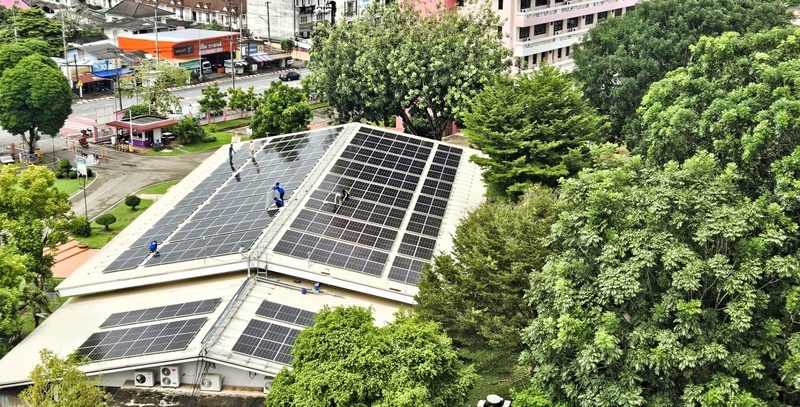
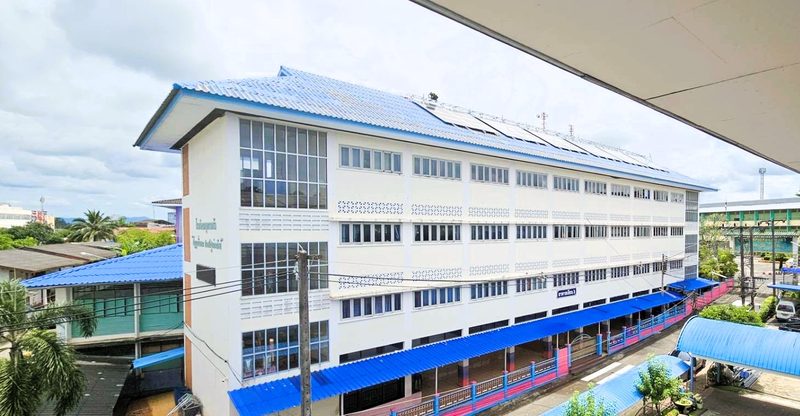
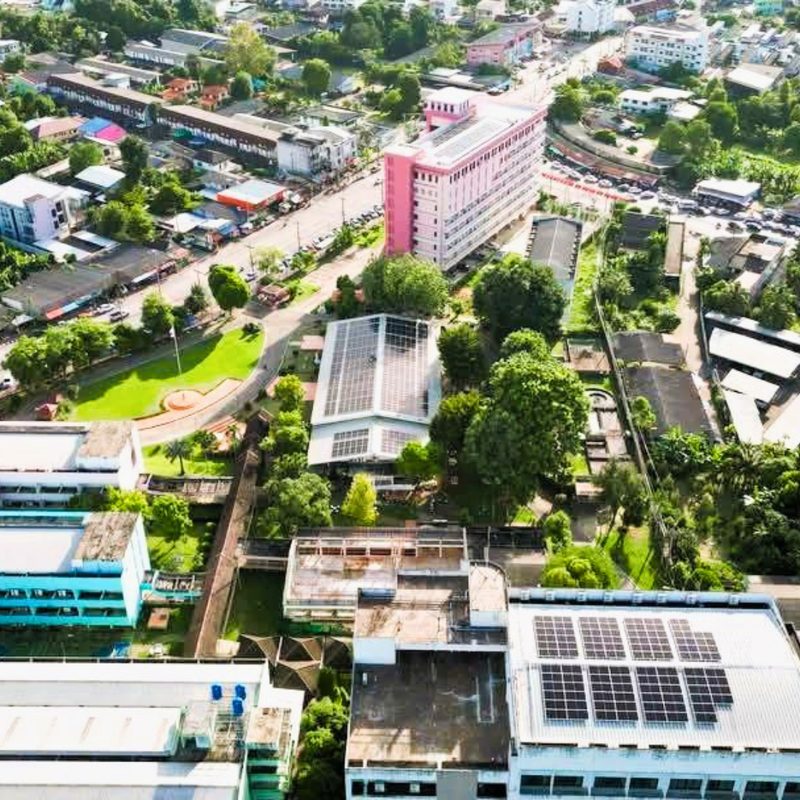
Schools, colleges and businesses with the kind of daytime load that makes solar pay fastest. Tap a photo for the full project.
From load study to long-term performance
Load & tariff analysis
We review 12 months of bills and your tariff class to understand consumption shape, peak demand and what solar can realistically displace.
Technical survey
Roof structure and loading, switchgear, transformer capacity, cable runs and grid connection constraints.
Design & financial model
System design plus a clear model of capital cost, annual saving, payback and lifetime return — with the assumptions written down.
Install, monitor, maintain
Phased installation to avoid disrupting trading, then monitoring and a scheduled O&M programme to protect output.
A solar asset is only worth its output
Commercial systems quietly lose money when nobody is watching them. A failed string, a tripped inverter or a year of dust and salt build-up can cost far more than the maintenance would have.
Performance monitoring
We watch actual output against expected output and investigate when the gap grows.
Scheduled cleaning & inspection
Panel cleaning, connection checks, thermal inspection and mounting integrity — important in coastal, salt-laden air.
Fault response
A local team that can physically attend, rather than a support ticket handled from another province.
Takeover of existing systems
We maintain and repair commercial arrays installed by others, including systems whose original installer has gone.
Commercial solar questions
How long does commercial solar take to pay back?
Typically around three to five years for a business with strong daytime consumption, though it depends heavily on your tariff class, load shape and how much of the generation you use directly. Businesses that operate seven days a week do better than weekday-only operations, because weekend generation isn't wasted.
Will installation disrupt our operations?
Rooftop work is largely independent of what happens below it. The disruptive part is the electrical tie-in, which requires a short shutdown — we schedule that for your quietest period, often overnight or during a maintenance window, and phase larger installations accordingly.
Can we export surplus power?
The 2026 household rooftop buyback scheme is for residential users up to 5 kW AC, so it doesn't apply to commercial systems. For businesses the economics come from self-consumption, which is why correct sizing matters so much — a commercial array that generates more than you use is capital you don't get back.
What about roof structure and warranties?
We assess structural loading before design and specify mounting appropriate to your roof type and its remaining life. If your roof is near the end of its life, we'll say so — installing a 25-year asset on a roof needing replacement in three years is a false economy.
Do you work outside Phuket?
Yes. We regularly work across Phang Nga and Krabi, and can deliver larger projects elsewhere in Thailand through our partner installer network while retaining project oversight.
Find out what your business could save
Load analysis, site survey and a written financial model — no obligation.